
E05850
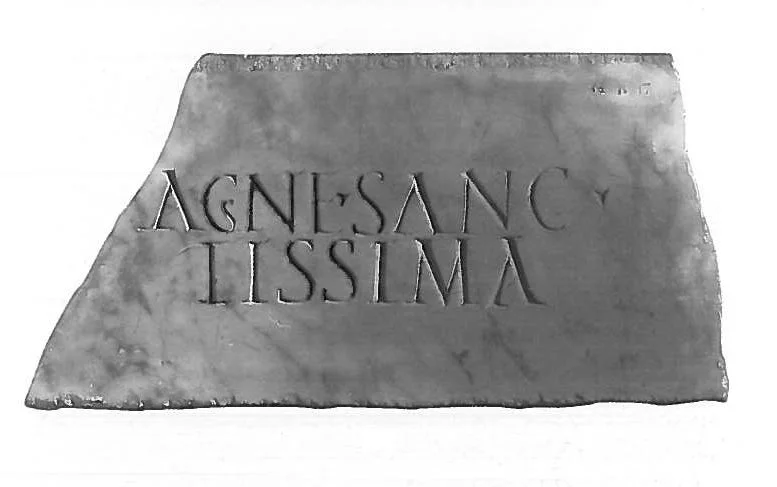
High quality inscription for a woman named Agnes, apparently from one of the Roman suburban cemeteries. Sometimes presented as the epitaph for, or a monumental dedication to, *Agnes (virgin and martyr of Rome, S00097). Probably 3rd or 4th c.
- Language
- Latin
- Date from
- 250
- Date to
- 400
- Evidence type
- Archaeological and architectural; Inscriptions
- Evidence subtype
- Formal inscriptions (stone, mosaic, etc.); Funerary inscriptions; Internal cult fixtures (crypts, ciboria, etc.)
- Evidence region
- Rome and region
- Evidence location
- Suburban catacombs and cemeteries; Rome, Rome, Roma, Ῥώμη, Rhōmē
- Cult region
- Rome and region
- Cult location
- Suburban catacombs and cemeteries; Rome, Rome, Roma, Ῥώμη, Rhōmē
- Cult date from
- 250
- Cult date to
- 400
Text
Agne sanc-
tissima
'O Agnes, the most saintly one!' or 'Agnes, the most saintly one.'
Text: ICVR, n.s., VIII, no. 20881 = ICVR, n.s., I, no. 2816 = EDB13259 and EDB35658.
Source
Marble plaque broken into two conjoining fragments. H. 0.31 m; W. 0.62 m; Th. 0.035 m. Letter height 0.055-0.06 m. Very fine lettering.
The inscription first appears in the archive of Luigi Gaetano Marini (18th c.), as retrieved from one of the suburban cemeteries of Rome. Seen by Ignazio Maria Raponi (18th c.) in the Galleria Borghese. First published in 1819 by Clemente Cardinali, from a manuscript copy by Raponi. In the mid 19th c., Theodor Mommsen rediscovered it in the royal Bourbon museum in Naples (now the Museo Nazionale Archeologico of Naples), and republished it in 1852 from the stone itself, as a pagan text (for an ordinary woman). Later re-edited by many scholars, notably twice in the new series Inscriptiones Christianae Urbis Romae (in vol. I by Angelo Silvagni, and in vol. VIII by Antonio Ferrua). For a list of editions up to 1983, see the lemma by Ferrua.
The original stone is now in the National Archaeological Museum of Naples, a 19th c. copy is displayed at the entrance to the catacombs of Agnes, in front of a modern sarcophagus dedicated to the martyrs Agnes and *Emeritana (companion of Agnes according to her Martyrdom).
Discussion
Based on the written records of the discovery of the stone, Ferrua suggests that this is almost certainly the epitaph for a Christian woman buried in a Roman suburban cemetery. Her identity is to him less clear. He notes that it was Armellini who first connected the inscription to the cemetery of Agnes, based on the mention of the name Agnes, the epithet sanctissima (which could also be given to an ordinary deceased woman), and the high quality of execution. The latter argument may speak in favour of Armellini's identification, but is in no way decisive. Orazio Marucchi was, for example, sceptical about this attribution. Hence, the text was also originally edited in the first volume of the ICVR, collecting inscriptions of uncertain origin.
This inscription is not believed by most modern scholars to be connected with Agnes the martyr. In particular, there is no evidence (other than the name) to connect it with the shrine of Agnes on the via Nomentana.
For a graffito with a similar formula, see E05836.
Dating: Editors of the Epigraphic Database Bari date the inscription to the 3rd or early 4th c.
Bibliography
Edition:
Epigraphic Database Bari, nos. EDB13259 and EDB35658, see http://www.edb.uniba.it/epigraph/13259
http://www.edb.uniba.it/epigraph/35658
Camodeca, G., Solin, H., Nasti, F., Parma, A., Kajava, M. (eds.), Catalogo delle iscrizioni latine del Museo Nazionale di Napoli (ILMN): Roma e Latium (Napoli: Loffredo, 2000), no. 450.
De Rossi, G.B., Ferrua, A. (eds.) Inscriptiones Christianae Urbis Romae Septimo Saeculo Antiquiores, n.s., vol. 8: Coemeteria viarum Nomentanae et Salariae (Vatican: Pont. Institutum Archaeologiae Christianae, 1983), no. 20881 (with further bibliography).
Frutaz, A.P., Il complesso monumentale di S. Agnese (Rome: Tipografia poliglotta vaticana, 1976), 178, note 122.
Diehl, E., Inscriptiones Latinae Christianae Veteres, vol. 1 (Berlin: Apud Weidmannos, 1925), no. 2004.
Marucchi, O., Le catacombe romane (Rome: Desclée, Lefebvre E.C., 1905, 2nd ed.), 356.
Marucchi, O., "Resoconto delle adunanze tenute dalla Società per le conferenze di Archeologia cristiana", Nuovo bullettino di archeologia cristiana 14 (1908), 235.
De Rossi, G.B., Silvagni, A. (eds.), Inscriptiones Christianae Urbis Romae Septimo Saeculo Antiquiores, n.s., vol. 1: Inscriptiones Incertae Originis (Rome: Ex officina libraria doct. Befani, 1922), no. 2816.
Armellini, M., Il cimitero di s. Agnese sulla via Nomentana (Rome: Tipografia Poliglotta della S.C. di Propoganda Fide, 1880), 68, 264, Tav. XIII no. 3.
Mommsen, Th., Inscriptiones regni Neapolitani Latinae (Lipsiae: G. Wigand, Neapoli prostat apud A. Detken, 1852), no. 6690(9).
Cardinali, C., Iscrizioni antiche inedite (Bologna: nella Tipografia Nobili, 1819), 31, no. 174.
Further reading:
Lapidge, M., The Roman Martyrs. Introduction, Translations, and Commentary (Oxford, 2018), chapter XVII.
Images
Associated saints
| Saint | Name in source | Certainty |
|---|---|---|
| Agnes, virgin and martyr of Rome (S00097) | Agne | Uncertain |
Cult classifications
- Cult Places
- Burial site of a saint - cemetery/catacomb; Burial site of a saint - crypt/ crypt with relics; Burial site of a saint - tomb/grave
- Non Liturgical Activity
- Prayer/supplication/invocation
Record author
Paweł Nowakowski
Entry date
22/06/2018
Citation
Paweł Nowakowski, Cult of Saints, E05850 — https://csla.history.ox.ac.uk/record.php?recid=E05850